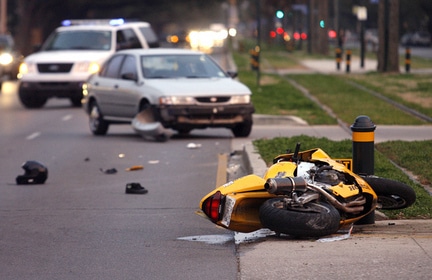
 The median of a highway in front of a restaurant had temporary traffic dividers. A man operating a motorcycle collided with a restaurant patron exiting the restaurant parking lot. Not realizing only a right turn was possible, the patron at first attempted a left turn and the motorcyclist collided with the patron. Plaintiffs are the parents of the motorcyclist, who died in the collision. The parents allege the restaurant “chose profits over public safety by failing to pay the additional $8 per hour to have another attendant on duty” to direct or assist patrons exiting the parking lot. Finding the restaurant had no duty to decedent, the trial court sustained the restaurant’s demurrer without leave to amend. The appellate court reversed, finding plaintiffs should be given leave to amend, and commenting: “[O]ur analysis of the Rowland factors [Rowland v. Christian (1968) 69 Cal.2d 108, [70 Cal.Rptr. 97, 443 P.2d 561]], indicates that the facts here support finding defendant had a duty to warn patrons of the danger in exiting its parking lot as it was on notice of the dangerous conditions of the highway and the risk it posed to patrons leaving the restaurant as well as the danger to persons traveling the highway from a patron exiting the lot in an unsafe manner. First, given the center divider in the roadway, it was foreseeable that patrons exiting at night might not be aware of its presence and make an unsafe turn. At night the dividers in the road would be more difficult to see and patrons leaving the restaurant may have consumed alcohol. Second, an unsafe turn would likely cause harm either to the patron leaving the parking lot or persons on the roadway. Third, there is a close connection between [the restaurant’s] failure to warn and the injury plaintiffs’ decedent suffered. The remaining factors are closely connected: there is moral blame that can be attached to defendant’s failure to take minimal, inexpensive steps to avert harm to its patrons and persons in the roadway. Prominent reflective signage and driveway paint would have done much to avoid the accident here.” (Annocki v. Peterson Enterprises, LLC (Cal. App. Second Dist., Div. 1; December 5, 2014) 232 Cal.App.4th 32 [180 Cal.Rptr.3d 474].)
Leave a Reply
You must be logged in to post a comment.